Piano Connections with Barbara

DO YOU LOVE IT ENOUGH? April 28, 2026 

I have been reworking the Grieg Piano Concerto for my concerts this weekend here in West Virginia. The first time I learned this concerto, I was a young high school student living in Philadelphia. I had entered a local competition to play a concerto with an orchestra in New Jersey and for that audition performed Chopin‘s E minor Concerto. I won the contest and was so excited because this would be my first time playing with a full orchestra and not just with a second piano playing the orchestral parts. I also remember that one of the judges at that audition was the late Natalie Hinderas, a prominent pianist who taught at Temple University and played lots of concerts around the Philadelphia area. Needless to say I was delighted for this wonderful opportunity.

Shortly after that audition, I received a call from the conductor asking me if I would play the Grieg Piano Concerto instead of the Chopin as he thought it would make a much better season finale for everybody involved (including the orchestral musicians as Chopin doesn’t give the players that much to do.) I enthusiastically agreed even though I had never learned the Grieg Concerto, but I was young and eager and encouraged by my piano teacher to practice as much as necessary to learn this new composition and have it memorized in time for the performance a few months later.  Frankly I don’t remember much about that concert- I wish I had a tape of it but I believe it went off without any mishaps or problems, thanks to the diligence of my piano teacher who had prepared me extremely well for the occasion.

Years later when I was playing concerts internationally, I had the opportunity to tour with an English orchestra and perform several concerts with the Grieg Piano Concerto. That must have been around fifty years ago! When the conductor here in West Virginia suggested our playing the Grieg together, I was a bit reluctant. I hadn’t looked at this work in a long time and frankly didn’t remember much about those concerts. But it’s definitely a concerto that everyone loves! When I read through it once again and heard those glorious melodies and its wonderful virtuosic pianism, I was convinced to give it another whirl.

I have been reworking this concerto from scratch as if I were just beginning to learn a brand new work. It sure feels like a new challenge to me. Perhaps I didn’t dig deep enough before to appreciate what Grieg was expressing and had underestimated the purity and the simplicity of the statement. I didn’t understand the depth and sincerity of his direct language. More importantly, I confess that I didn’t allow myself to love it enough when I first performed it professionally fifty years ago. I am older now and my musical judgements about this work have truly changed. I feel that at this time in my life, I can experience more directly the soul of the composer and the beautiful love letter he has written from the purity of his heart. Grieg wrote this work shortly after he had married and his love for his partner is evident in every phrase.

To get on the stage and perform at the highest level, it is a prerequisite to not only believe in what you are doing but to love what you are doing. Only then can you convey that feeling to those who listen. And there is so much to love in this young composition of Edvard Grieg. It sounds to me like he was writing a love letter to life.

The question remains:  if the artist is not convinced about the music he performs, how can he possibly convince his audience. Similar to the adage, if you’re not having fun at the piano, how can you expect others to enjoy what you are doing!! So the journey continues, and we keep digging deeper, always trying every time to climb up that mountain!

THE OUTSIDER April 13, 2026 

I’ve always thought of Serge Prokofiev as a true outsider, He was a man who always marched to his own drummer, remaining true to himself and honoring his talent — always his own man.  Even as a young conservatory student Prokofiev never followed the rules. Being the natural talent he was, it’s not surprising that he couldn’t conform to function as part of the governing majority.

What I have discovered in studying the man and his music is his belief in his natural talent, nurtured by his mother since early childhood. He never doubted his gifts in spite of the hardships encountered after his return to the Soviet Union.

There is a very telling photo of Prokofiev with his partner Mira Mendelssohn from 1948 when they were attending a meeting at the Composer’s Union in Moscow most likely on the day when the decree condemning the compositional techniques of “formalist” composers was read. That would have included the music of Prokofiev and Shostakovich among others The photo captures both the fear and the astonishment of what he had probably just heard. Prokofiev was never a part of the bureaucratic system nor did he know how to maneuver within the power structure. Having spent so many years living in the West only added to the perception of Prokofiev as the foreigner, the outsider.

Prokofiev has been greatly misunderstood for his decision to return to the Soviet Union in 1936. Granted he was wined and dined by the Soviets and given empty promises, but it was never a political decision. He only wanted to be left alone to write his music and have it performed, but unfortunately that was no longer possible after the 1948 decree.

Perhaps all great artists are outsiders because of their unique and individual voices. The innovators usually have to swim against the current to forge their own pathway. Remember that funny one-liner by Groucho Marx, “I don’t want to be a member of any club who would have me as a member.” Prokofiev was definitely not a member of their club; he never conformed or compromised his musical integrity. He just wanted his music to be heard, to exist and to be remembered. That’s what every artist wants—an acknowledgement that they and their work do exist in our universe and will be remembered for posterity. No formal decree could prevent that from happening to the music of Prokofiev.


WHY DO I KEEP PRACTICING! April 1, 2026 

I have been playing the piano since I was a little girl and now that I am entering the eighth decade of my life, I am still practicing and happy to say, enjoying it so much more! That’s a long time spent sitting at the piano, but what a blessing is has been for me!

My very first piano teacher reminded me of a drill sergeant with his stern uncompromising approach. Now looking through the scores we studied together, I see his writing, always in big bold letters, “drill, drill 100X a measure.” That’s definitely not the way I practice now. I’ll admit that his method might have helped develop strong finger technique, focusing primarily on a near note-perfect performance, but it definitely wasn’t much fun! There was never much talk about the music or the joy of playing the piano.

Now I have much more fun sitting at the piano. That process of digging deeper and uncovering each layer before going on to the next has become my daily journey of discovery and a distinct pleasure. I am not aiming for a note-perfect performance—that is never the point. What I am always trying to do is to get closer to the composer’s intentions, to understand his language and to speak it as naturally as possible so that it is easily understood and that it connects and reaches something  deep inside the heart— not only my heart but the listener’s as well.

I love the discovery process--figuring out how the work is put together. What is the structure and where is the dramatic climax? Where is the journey taking me emotionally and spiritually? My goal is to make the music sound as natural and as fresh as possible as if the composer himself had just sat down at the piano and played it for me for the first time.

Of course, with my dead composer friends of the nineteenth and twentieth century, I can only imagine what they themselves might have done. What I hear in my head doesn’t come from nowhere; it comes from a familiarity with their music and not only with their piano music. It’s about knowing their compositional style, their particular way of phrasing. For me, this becomes an editing process at the piano—understanding what will work or what doesn’t and evaluating what I am consciously doing at the instrument. Always experimenting and using my musical intuition, the process never remains the same, never stagnant— always changing  as new ideas and possibilities keep entering into the mix.

At the moment I am preparing Beethoven sonatas for recording and working on the ones I have never learned as a student. This is a composer who never makes it easy for the pianist. He challenges us on so many levels--technically, intellectually, emotionally, physically. He’s been my lifeline during trying times. When I am working on one of his sonatas, I can shut out the world and forget about the problems of everyday life. And all I need is the time to keep going deeper.

There’s a wonderful quote from the French writer Balzac who said, “Time is the sole capital for people whose future depends on their talent.” 

How right he was!  All of us need the time to focus and to concentrate, to get rid of the daily chatter, and to keep digging, to keep trying to get closer to that divine source.

And as all of us know, there never is enough time in our lives, is there!!

SECOND CHANCES! March 21,2026 

Second chances are a blessing! It’s a unique opportunity to get it right or at least get a little closer to setting things right. All of us have wished for a second chance—perhaps to take back those words we might have blurted out in the anger of the moment and in retrospect truly didn’t mean and after thinking calmly, regret its ramifications. How many times have we said to ourselves, if only I had handled that situation differently! Yes, none of us is a perfect human being, and we all share regrets. So who wouldn’t welcome a second chance.

Similar thoughts can be applied to performances I have given many years ago. Looking back now that I am much older, I think to myself, I would have done that so differently. So to get a chance at another opportunity to get a bit closer and to try and raise the bar is truly a gift.

I have been reworking Grieg’s Piano Concerto for an upcoming performance next month. The first time I played this work was way back in high school. I won a concerto competition with a local symphony orchestra, Having played the Chopin E minor as my audition piece, the conductor asked me to learn another concerto that would give his orchestra a little more to do than Chopin’s sparse accompaniment so he chose the Grieg- actually a very good choice for a young pianist as well as the audience.

Years later, as a professional concert artist, I was asked to do a tour with an orchestra in the UK with Grieg’s Piano Concerto. It wasn’t the concerto I would have chosen to play with them and perhaps that accounts a bit for the snotty attitude I had towards this work. To me at the time, the concerto sounded rather trite, a bit too banal, a little too predictable. Perhaps I had heard too many less than adequate performances of the work. In retrospect I was being grossly unfair both to the composer and to myself.

And what a gift to now rediscover this work with fresh eyes, without the influence of other people’s opinions. A second chance to try and get it right, to try to understand the composer’s intentions and not prejudge the music with any past prejudice.

I recall the wonderful story when the young Norwegian composer Edvard Grieg came to Weimar to meet the great Franz Liszt. Grieg had just completed his Piano Concerto and wanted Liszt to hear it. Liszt graciously welcomed Grieg to his public masterclass and asked the young composer to sit down and play his new work for everyone. Grieg refused saying he couldn’t play it. After being coaxed by Liszt several times, Liszt finally sat down at the piano and said,”well, I can’t  play it either!”


According to Grieg, he started the concerto much too fast but eventually got the tempo right and by the time he reached the difficult cadenza in the first movement, played it flawlessly. After Liszt finished, the master said to the young Grieg, “just keep going forward and never allow anything to deter you at your task.” Many years later Grieg said that Liszt’s words that day had made a huge difference in his life, and at difficult times he would remember what the Maestro had said to him. 

I now see this Concerto so differently. It happens to be a glorious work, filled with wonderful virtuosic pianism and beautiful melodies that evoke the Scandinavian landscape. Grieg makes us feel the desolation of the North country as well as bringing a purity to its simplicity. He gives the performer all the ingredients necessary to breathe new life into this popular work. 

Here is a second chance to get closer to what the composer might have intended.And now you know why playing the piano is so addictive!! We keep trying to raise the bar every time with each performance! Always trying to get it right!

LISTENING!! Mach 14, 2026 

Do most people know how to truly listen? Actually it’s not something that we have been methodically taught how to do. Granted, I would wager that many of us have been guilty at one time or another, of not listening carefully enough to exactly what was being communicated. Don’t we all know people who unconsciously block out unpleasantries that might be too disturbing, preferring to hear what they wish to hear? A self-protective mechanism can frequently kick in to alter objective listening. For many of us the truth might sometimes be too painful to digest during difficult periods in our lives.

And what about listening to music? Is there such a thing as a truly objective listener without any trace of lingering musical bias? Would most music critics qualify as objective listeners, or are they more comfortable with what they deem familiar? Might that not preclude an openness to new ideas and original interpretations?

I would argue that no two people hear exactly the same things when they listen to a musical performance. Many of us carry along the baggage of a personal and emotional musical moment lurking deep within our memory. Even when listening to the same recording, it never is the exact musical experience as previously heard. The more familiar we become with the music, the more comfortable we might be, and then perhaps, much more capable of refining and retuning our listening abilities.

When we walk outside, our ears don’t usually focus on extraneous sounds. We usually accept the soundscape around us until we are made aware of that bird chirping in the distance, and our attention is placed there; then we can begin to hear other layers of sounds that might be part of the total fabric. This is because our level of concentration and intensity has changed, and our focus has become sharper and much more directed.

As a performer begins to learn a new piece of music, practice is initially required for mastery of the notes and a general understanding of the total structure. The more familiar we become with the composer’s language and his unique conception, the more we try to hear what we are doing at the instrument, and a process of intense listening can begin. Always the focus should be to get closer to the sound world of the composer—to learn his language as if it were our native tongue. We strive for the impossible ideal of recreating the music the way it must have sounded to the composer at that first moment of divine creation when the muse appeared and her voice was heard.

That’s the real fun of practicing- always pursuing an ideal that is never truly achievable. The process can sometimes be frustrating but also exhilarating and extremely addictive. It’s exciting to just follow the pathway to wherever it might lead as we strive to get closer and better! Always raising the bar!

And always listening—that is the challenge of a lifetime!


“Music is enough for a lifetime but a lifetime is not enough for music!”
                                                                   Sergei Rachmaninoff

PERFECTION? January 9, 2026 

Does perfection exist in musical performance? If so, what are the criteria? And is there a consensus of opinion in choosing the “perfect” performance?

During the past few months, lovers of the sport of piano competitions have had plenty to watch on you-tube and much to discuss and argue about. The Chopin competition in Warsaw and the Van Cliburn Competition that is held in Texas attract a large and enthusiastic audience. One can only imagine what transpired within the confines of the jury room with the diverse opinions of an international jury of judges.

Everyone seems to be looking for the “perfect” performance, but does that even exist? And if it does exist, how would it be defined? Does it boil down to playing all the notes accurately and in tempo with the proper expressive markings as indicated in the score? Many pianists can easily master that but not all note-perfect performances qualify as reaching the heights of true artistry and soaring to a magical level!

I don’t believe that there is ever one “perfect” performance.  Isn’t this the reason that we keep listening to various artists interpret the same Beethoven sonata? Each performer brings their unique artistry and character to their performances, and every performance is different than the previous one— never exactly the same. Horowitz does not resemble Serkin in his interpretation; both are individuals with a personal point of view.

I recently was told about the masterclasses of a prominent piano professor who refused to teach the same work more than once in his classes. He believed that there was only one way to play the work — his way and he presumed that  was also the composer’s way! But doesn’t each performer possess the possibility to discover something new and different within a great piece of music? Isn’t it the responsibility of the teacher to address the individuality of the student and their special needs? I would argue that there is always something new to discover within a piece of music, and that fact is built into the definition of a great work’s profundity.

That is why performers keep digging and never seem to reach their quest as they try to get closer to the original conception of the composer. I believe that with all great works of music, creation is divinely given.  Stravinsky when asked about the greatest interpretation of one of his works replied— “when I heard it for the first time in my head.” In other words, when the muse spoke to him, that was his perfection!  And the ideal of the interpreter should be to come as close to that divine moment when the work was initially conceived by the composer.

That is our work for a lifetime. Rachmaninoff was right when he said, “music is enough for a lifetime but a lifetime is not enough for music.” The prolific French writer Balzac wisely observed that “time is the sole  capitol for people whose future depends on their talent.” So we keep trying to scale that mountain peak with the time we have left— never reaching perfection but getting a little closer every  time!

MEMORIES OF AMSTERDAM! July 4, 2025 

Amsterdam was the first European city I ever visited.  I was a bit of a late bloomer when it came to foreign travel. Most of my college friends had been much more adventurous and were already seasoned travelers, backpacking throughout Europe on five dollars a day. I chose to spend my summers at the piano preparing for the concert career I had been dreaming about since I was a child. I had no idea how it would come about, but I was certain that one day I was going to be traveling the world and playing the piano. That’s all I ever wanted to do with my life.

And then it happened! When I remember all the details of that afternoon in May of 1969, it sounds a bit like a Cinderella story. I was at the University of Michigan finishing up my doctoral degree. As usual I could be found at the School of Music working alone at the piano in one of the basement’s practice rooms.  The knock on the door jolted my concentration, and in stepped the Dean’s Secretary to tell me that I better go home and change clothes because in two hours time I would be playing for Eugene Ormandy.  He was in town with the Philadelphia Orchestra, for the annual May Festival. The maestro had attended a luncheon and sitting next to him was one of the Regents of the University, Eugene Power, the founder of University Microfilms and a great supporter of the arts who frequently attended my concerts. He mentioned to the maestro   that there was a very talented pianist in the Music School; Ormandy immediately responded by saying, “Let me hear her; I have one hour free before dinnertime.” 

What took place in the Recital Hall of the Music School that afternoon would alter the course of my life and clarify my musical pathway. Seated in the back of the hall was Maestro Ormandy accompanied by Regent Power. On the other side of Ormandy sat my piano professor, Gyorgy Sandor. The audition began with Ormandy asking me to play the cadenza from Tchaikovsky’s First Piano Concerto, then he shouted for the cadenza from Rachmaninoff’s Concerto No. 3, then the cadenza from Beethoven No. 4 and finally a solo work. I think I might have played the finale of the Chopin B minor Sonata that I was studying at the time.

Frankly, I have no idea how my fingers managed to recall all these notes. I am sure I received some added help and inspiration from above.  After the audition, all of us proceeded to the office of Regent Power, and Ormandy dictated a letter to his European manager in Holland, Johanna Beek asking her to arrange my first European tour, with debuts to be scheduled in all of the major European cities. That’s how it began. The Power Foundation generously awarded me a post-doctoral grant to fulfill my dream of playing concerts and traveling throughout Europe.

I would be following the route of most American opera singers of the time, going to Europe to begin building a professional career. When the time was right, I planned to return to the US to make my New York debut and acquire American concert management. Thank goodness, there was no need for me to pursue the piano competition route as my temperament would not have thrived in that environment. Bela Bartok was right when he said, “Competitions are for horses!”  I could not agree more! There were so many more performance opportunities in Europe for a young unknown artist to be heard. In Holland, a country the size of the state of Kentucky, the arts were subsidized by the government and there were 28 orchestras that served not only the major musical centers but all the smaller towns. A guest soloist could be engaged by a touring regional orchestra and perform the same concerto several times in succession. What a wonderful way for a young artist to gain experience as a soloist and begin to discover and define their individual voice.  More importantly, after achieving success with the public, an artist would not need to wait ten years for a reengagement; they might be invited back the next season to play another concerto.  That’s what happened after I played a successful debut concert in Copenhagen, Denmark, the first stop of my concert tour. The press were unanimous in their praise and requested to hear me again, so I was invited to give another recital several months later with different repertoire. That marked the beginning of many return trips and performances throughout Scandinavia. In general, European audiences were critical and discerning listeners, and the arts were a vital part of their daily life.

When I stepped off the plane and arrived in Amsterdam, I knew that I was about to discover a brand-new world, and I was so eager to embrace the experience. I had no desire to be perceived as just another American tourist or labeled “the ugly American.” Remember this was the seventies, the time of the Vietnam conflict and our approval rating around the world was not at its highest level. The Dutch people had been extremely critical of our involvement in the war. That brings me back to my first night alone in Amsterdam. After settling into my hotel, I went out in search of a nice restaurant to have my first meal in a foreign country. The gracious waiter assuming I was a “local” handed me a menu in Dutch. Of course, not wanting to be perceived as a typical tourist, I did not object and pointed to an item on the menu that seemed to sound appealing even though I had no idea what I might be ordering. Of course, I did not realize at the time that most Dutch people were proficient not only in English but at least several other foreign languages. I can still remember my surprise and complete loss of appetite when the waiter delivered a plate with two huge, bloated sausages topped by plenty of pungent sauerkraut and placed it in front of me. That was one evening when I settled for only ice cream for my dinner!

I must admit that I have traveled a long way since that first evening in Amsterdam. While pursuing my musical career this city served as my European home for over ten years. I was able to travel throughout the country and give recitals and appear as a soloist with most of the Dutch orchestras. My very first recording, an LP for CBS Records of works by the Argentine composer Alberto Ginastera, was recorded in the city of Haarlem, not too far away from Amsterdam. I have come to love this beautiful city with its narrow canals, its many bicycles, its magnificent museums, its glorious concert hall and let’s not forget all those beautiful flowers!  I treasure the long-lasting friendships I have made.  Even though all my Dutch friends spoke perfect English, I tried to learn a few words of their difficult language and had so much fun with weekly lessons from my ninety-year-old Dutch teacher. When I was engaged to play a special summer concert on one of the canals in Amsterdam, she patiently coached me so I could say at least a few introductory words in Dutch to everyone present that evening. 

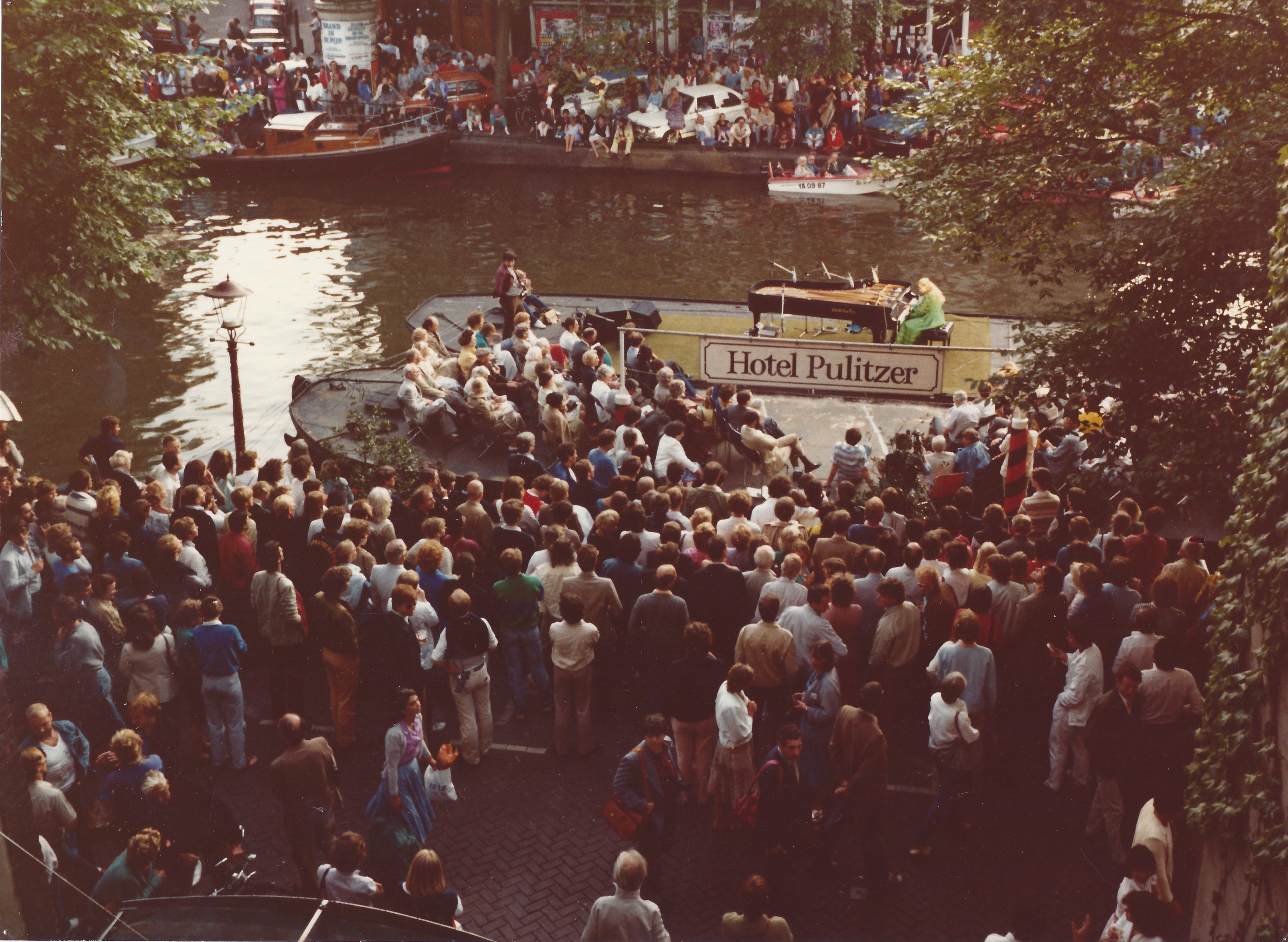
And let me tell you about that memorable concert!  It was conceived over drinks with dear friends at the bar of the Pulitzer Hotel, located on the Prinsengracht canal. It’s a beautiful hotel that magically blends the old with the new; the sixteenth-century canal houses remain but have been modernized to luxury hotel standards. When the manager of the Pulitzer, Theo Inniger suggested to his good friend Hans Duijf that they put a concert grand in the middle of a barge on the canal and present a free concert, they then both turned to me. We all agreed that this was a great idea, and this event seemed right up my alley. In addition to playing serious concert venues throughout Europe, I was also working in the States for Deere & Company the farm equipment manufacturer as their artist-in–residence. This was the first time an American corporation had hired a classical musician to present concerts for their factory workers in the US and abroad. I had also appeared in some rather unusual places, performing in prisons, on Indian reservations in Arizona, in schools, hospitals, shopping centers. If there were a piano available, I would play, and this event sounded like lots of fun. The plan was to shut down the canal to its usual traffic just for the evening; seat the VIPs on the barge around the grand piano and the overflow audience would be standing around the canal in addition to the audience of boats with their passengers on the water. 
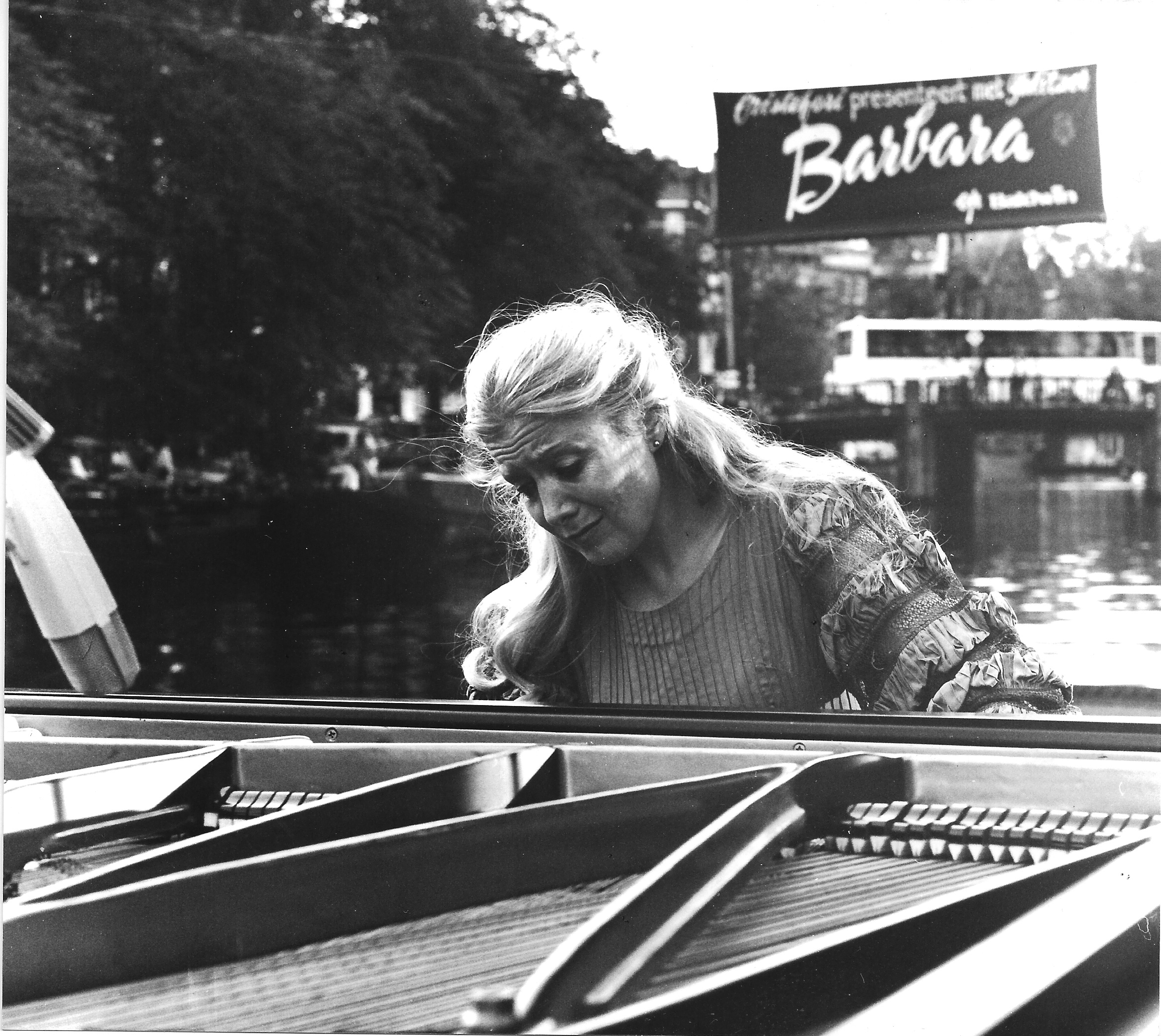
However, not everything went according to plan. That very week, I had been riding my bicycle in Amsterdam and was hit by a car that had run through a red light. Luckily no limbs were broken, but my legs were bandaged underneath my concert dress. And then there was the grand piano that needed to be moved. Unfortunately, just as it was being lifted onto the barge, the crane holding the instrument snapped and the piano fell! Sadly, it arrived on the roof of the newly bought car of the piano transporter- a brand new Volvo. Remember that commercial: “Nothing destroys a Volvo!” Miraculously, the piano was intact but not the Volvo! After the resident piano tuner did a thorough check of the instrument, now with its broken lid removed, it was given a clean bill of health, and the show went on as planned!

The piano turned out to be the real star of the show and the “drop” made the front pages of every Dutch newspaper the next day. If you happen to be in Amsterdam sometime in the near future and would like to check out the scene of the crime, just go to the Pulitzer Hotel. As you enter, look up and take notice of the grand piano suspended from the ceiling in the foyer. No, it’s not the same piano, but it is there to commemorate that unforgettable evening in August, 1982.

The concert that started off so dramatically marked the beginning of a beautiful summer tradition for the city of Amsterdam. Every August, the whole city gathers to celebrate the annual Prinsengracht concerts and to welcome international world-class artists who share their music-making with crowds of ten to twelve thousand people, all standing around a canal, filled with honking boats and jolly passengers raising a glass to celebrate the occasion. The concert is also transmitted live by AVRO television for the entire country to witness. When I returned in 2022 as a guest for the 40th anniversary celebration of these concerts, I was amazed by the experience- from a simple idea for a concert on the water, it has grown into a spectacular event for the entire city.  The excitement and joy of that evening was quite overwhelming. Walking out on that barge, the people of Amsterdam made me feel like a “rock-star” returning home and embraced me as a genuine Amsterdammer. What has been added to this event since its inception is the inclusion of the theme song of the city of Amsterdam that traditionally ends every concert. “Aan de Amsterdamse grachten” is everyone’s favorite tune and all join in to sing the praises of their beautiful city on the canals. 
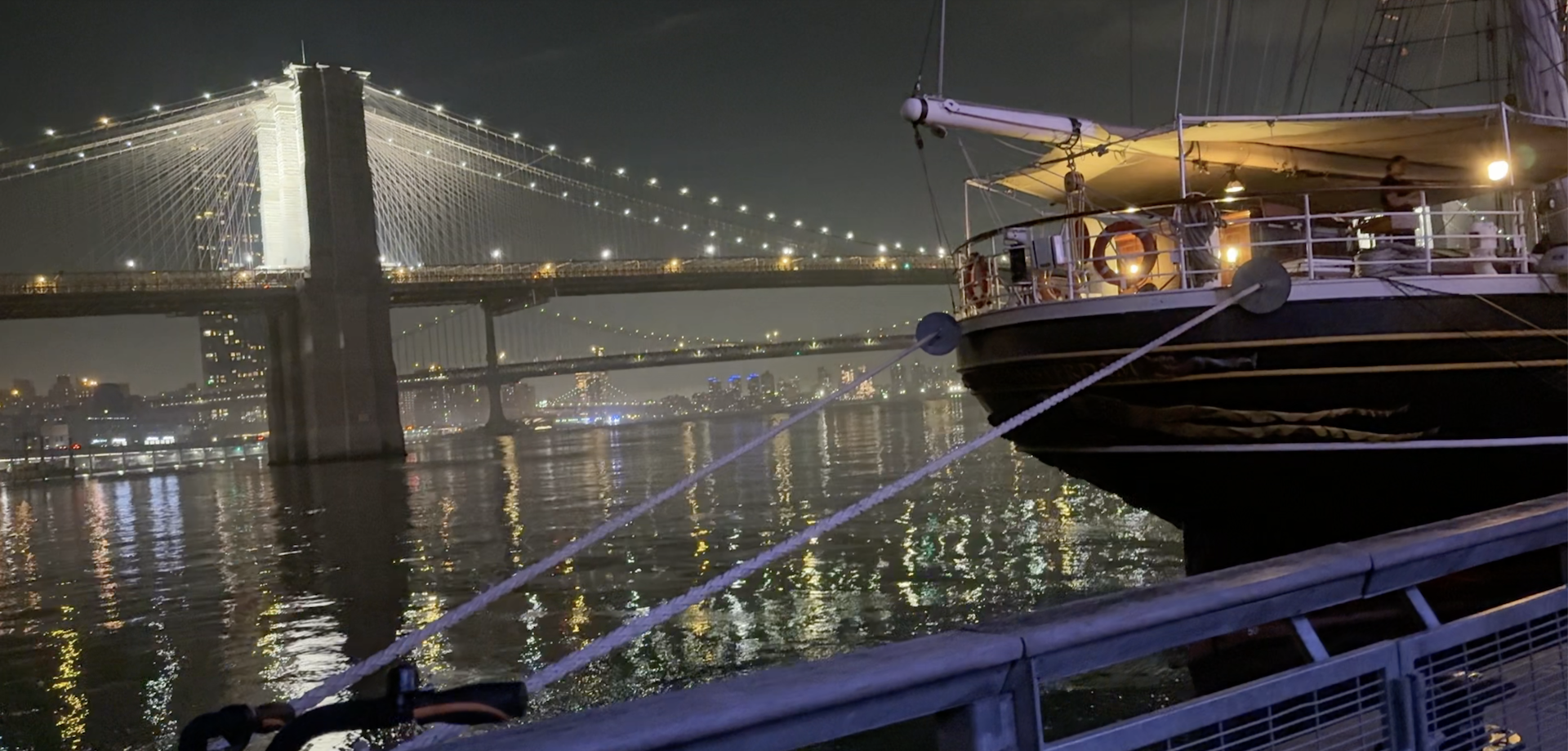
Recently the magnificent Clippership Stadt Amsterdam, a nineteenth-century replica of a tall ship, made its way to New York City’s harbor. As a generous gesture to the people of New Amsterdam (New York City) and in honor of their 750th anniversary, the city of Amsterdam along with Dutch sponsors, Heineken and Randstad Corporation, presented a concert on June 18th aboard this beautiful ship, and invited the public on the pier to listen. This was the American version of the Prinsengracht concerts—not on a barge on a canal but on Pier 17 at the South Street Seaport. And what a glorious evening it was! This time there were no major mishaps with the Steinway piano, only minor ones that were well-handled by Hans Duijf.  Because of the tides on the East River, the piano had to be delivered and removed at specific times. Everything was set to go like clock-work, except instead of the B concert grand (a 7-foot) that was requested, a smaller piano was delivered to the ship by mistake – not big enough for the repertoire I intended to perform, but Hans was there to remedy the situation, and another piano, a beautiful German Steinway, arrived just in time for the concert. It’s not easy to get a concert grand onto the gangplank but the movers were real pros and miraculously managed it! A crew from Dutch television was there to film a documentary about this special event. 
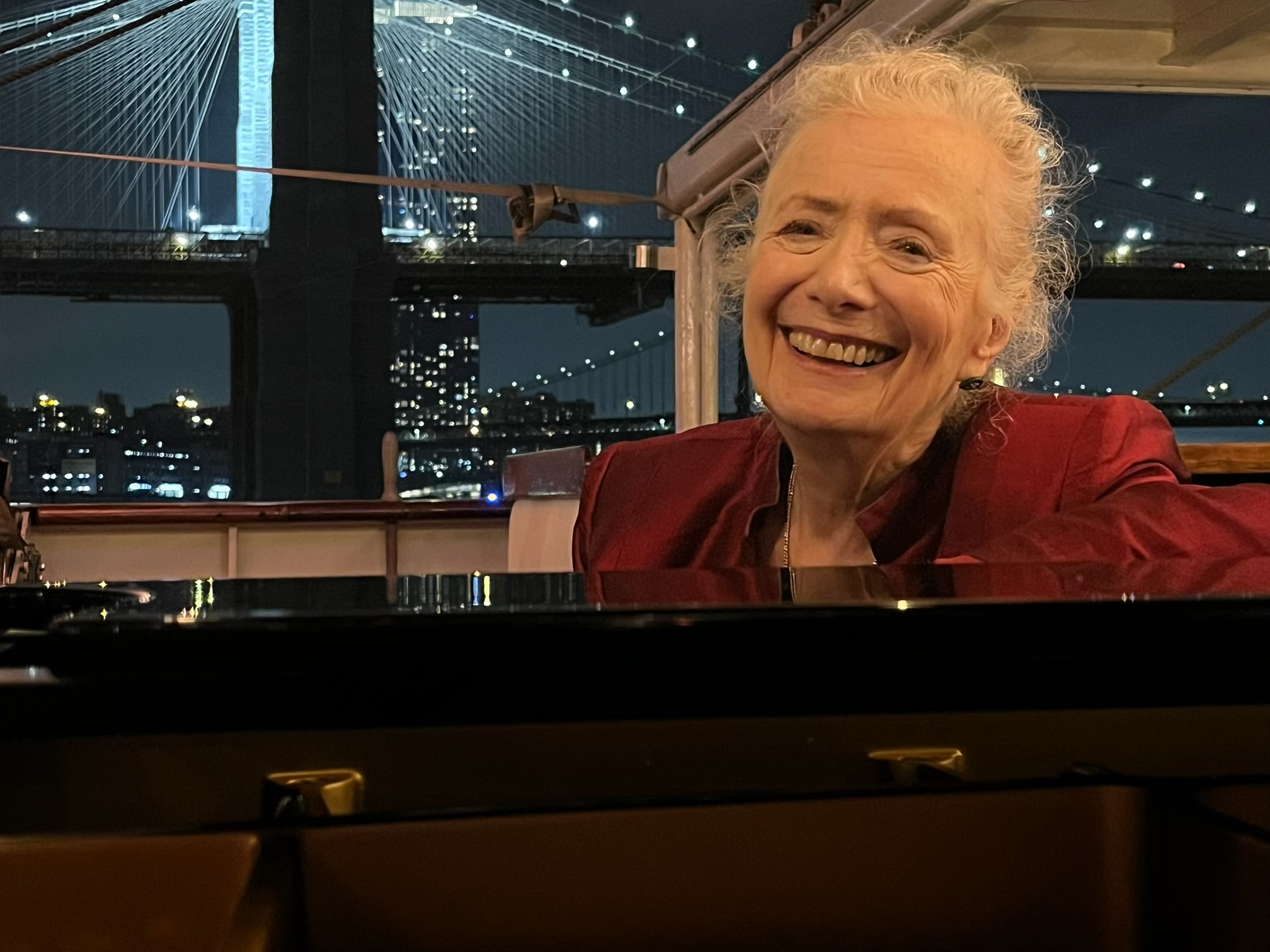
I must say that it took me a while to get used to the rocking of the ship when I arrived that afternoon to rehearse, but eventually my lightheadedness disappeared, and adrenaline kicked in just in time for our concert. As the American pianist who had helped initiate the Prinsengracht concerts in Amsterdam I was invited to perform at this Dutch celebration and began the New York concert program with music of Prokofiev, his first sonata that he wrote when he was 15 years old, Beethoven’s Moonlight, Clair de Lune, some joyful Ginastera dances and ended with the popular Second Hungarian Rhapsody of Liszt with lots of informal chat in between pieces. I had performed this music over 40 years ago in Amsterdam at our first canal concert. After the Liszt Rhapsody, I welcomed the beautiful and talented young Dutch violinist, Tosca Opdam, who flew in from Amsterdam just a few days before, to join me on stage for a brilliant performance of Ravel’s Tzigane, a touching Salut d’amour by Elgar and a Heifetz arrangement of a Gershwin song. Did you know that George Gershwin was born and raised on the Lower East Side of Manhattan, not too far from where the ship was docked? Then came our grand finale with Tosca and me performing everyone’s favorite song of Amsterdam with all the public joining in with the chorus. This was one tune worth repeating and that we did before celebrating with an elegant dinner, served by the wonderful crew on the Stadt Amsterdam. Truly a night to remember, and what a joy to be with old and new friends and be part of this Dutch/American celebration! 

Click here to see an excerpt from the Prinsengracht  40th anniversary concert from August, 2022

A COACH, A MENTOR? March 6, 2025 

A few weeks ago, I was in Pittsburgh for a concert, playing several sonatas by Prokofiev on a series at Duquesne University. It was a fun visit, and I also spent some time the day of the concert with my old friends at WQED Radio. Jim Cunningham and I reminisced about my debut with the Pittsburgh Symphony, performing Rachmaninoff’s Fourth Piano Concerto in their 1989-90 season. Lorin Maazel, the music director at that time had wanted me to perform this not too often played concerto. However, because of a scheduling problem, Aldo Ceccato stepped in as conductor, also making his debut with the PSO. What a joy to perform that work with the orchestra! It’s not an easy concerto to put together with all the dialogue that keeps passing back and forth between the pianist and orchestra, but it was an impressive collaboration! 

After that interview, my old friend Anna Singer and I went on the air “live” to talk about Prokofiev and the concert that evening. In addition to her talents as a superb interviewer, Anna is a wonderful singer, and she managed to surprise me with a question I hadn’t expected. Anna wanted to know if I still coached with anyone before my concerts. Actually, it wasn’t such an unusual question for a singer to ask; lots of professional singers still work with vocal coaches especially when preparing new operatic roles.

Her question made me think about how I as a pianist prepare for a concert performance. No, I do not coach with anyone, at least not with any “living” pianist, but as I answered her on the air, I do receive “coaching” from my dead composer “friends.” There is always the feeling that I am being led, with their help of course, in the right direction. It’s as if there is a voice somewhere saying in my ear, “No, you haven’t gotten it yet; let’s try it again…” 

Am I guided by my own instinct, or do I truly believe that I am receiving some sort of “spiritual” help from above? Perhaps it is a combination of having lived with the music I am performing for a long time as well as living with these composers and their individual voices. It’s as if I am hearing them speak, understanding their language, and being granted the gift of participating in an ongoing conversation. My goal is to transform what might appear to be a foreign language to many, into a natural expression of pure feeling that will reach deep into the hearts of the listener. And I want to convey the joy and the greatness of the music I am sharing!

Anna’s question made me think back to my principal piano professor at University with whom I studied for seven years. I had arrived as a talented freshman on a full scholarship at the University of Michigan and was assigned to his class, even though he primarily taught only doctoral students. I then continued studying with him for all my degrees including a doctorate, mainly to prepare more repertoire for a future performance career. 

Looking back, I can accurately say that he was probably the “right” teacher for me at that time, and most likely would not have been a suitable mentor for a less advanced student. When I arrived at the age of seventeen, I could find my way around the keyboard without problems. Although initially what he was advocating was a challenge for me, he did add to my already advanced technique and succeeded in making playing the piano even easier for me. In addition to my excellent finger technique, he also suggested incorporating the wrist and arm weight, using gravity to enhance my sound at the keyboard. His approach was not as safe and accurate (at least not in the beginning) as my secure digital way of playing. However, he helped me to understand technique and the principles behind what I had been doing naturally and instinctively. That meant that no matter how difficult technically any passage might appear to be initially, there was always a logical way to approach it and solve the problem without tension, without tiring and always with a beautiful sound. 

I remember as a freshman attending my first master class with him and all his doctoral students. Someone had just played one of the Chopin Etudes and the discussion was about the correct technique involved. To me, they all could have been speaking Greek because I did not understand one word of what they were saying. I naively thought to myself that if you keep practicing the passage over and over again, eventually it will come. Of course, without a conscious knowledge and exact understanding of what you are doing. that only takes you so far. Nobody had ever spoken to me before about piano technique. My first teacher had advocated repetition as the only way to learn and master a passage. Written all over my scores under difficult measures were the words “Drill 100 times per measure.” Drill baby drill!! That was the way I was taught to practice. An awareness of form and structure and harmony and the study of the science of piano technique came only later, as a university student.

My professor, Gyorgy Sandor had studied with the composer Bela Bartok. What is curious is that  Bartok had chosen not to be a professor of composition at the Liszt Conservatory in Budapest and had opted to only teach piano. According to Sandor, his method of teaching was for the students to gather around the piano and listen to him play through the composition they were studying; there was never any mention of piano technique. That is the reason that Sandor had to discover for himself the principles involved in playing the piano. To that end, he produced a book “On Piano Playing” that provides the most lucid discussion of how to play the piano without tension and what method to use to overcome any difficulty. Reading his book is exactly the way I was taught as one of his students.  None of his students’ playing resembled his own, and that is a compliment to his teaching methods; he never set out to make us clones of himself. Instead, he tried to give to each student what their individual technique lacked. He concentrated always on the bigger picture- the structure – the large form, opting to emphasize this at the expense of working on details. Those were left to the students. It was their job to discover their own voice and to find their way within the music. All the tools were given to create a personal statement. 

Without the tools of technique, the musical journey to discover the soul of the composer and how to interpret his unique voice is nearly impossible. Without the freedom to rise above the notes, making music will remain earthbound, just a series of passages usually played without much meaning. With each performance, we try to raise the bar a little higher than the last concert and get a bit closer to the voice of the composer. That is the responsibility of every performer!!

And so the journey begins again but never quite the same as the last time— always different!

Click here for Barbara’s performance of the Rachmaninoff Concerto No. 4 with the Pittsburgh Symphony https://www.youtube.com/watch?v=yX3ierxG-H8&list=PLNXjZzwMqcB-h5GzGPTEK8qubccRZAZop&index=13&t=38s


LOOKING FOR THE ATTIC, February 17, 2025 

I was born and raised in Philadelphia, in the northern part of the city, and grew up in a neighborhood of row houses. During the fifties, it was a close community where everyone knew and cared about each other. Most of the women were stay at home moms. Children would be playing in the streets while mothers sat outside to gossip and monitor all that was going on. My family home was the second one on the block, with each house being attached with neighbors on either side. A duplex apartment was on the corner and that meant not one, but two tenants shared that common wall as well as the family who lived on the other side of us. Back in those days, prior to air-conditioning, all the doors and windows were left open in summer. That meant that everybody on the block could hear me practicing and would monitor my progress. All the neighbors knew that I was the little blonde girl who played the piano.

Most of the children in that middle-class neighborhood also took piano lessons. A man by the name of Raimundo Marquez used to visit practically every kid on the block, charging two dollars for a weekly lesson. His success rate was impressive. He taught every child to read and perform at one of his annual piano recitals. My older sister was taking piano lessons and perhaps my hearing her trying to master Rachmaninoff’s C-sharp Prelude prompted me to beg my mother to learn the piano too. I was just five years old. 

A “one size fits all” approach was used to teach every one of his pupils. It was learning by rote and nothing more than “Repeat after me—first line E, second line G, etc.”  He would recite these lines over and over until memory would eventually kick in. Frankly, I never understood what he was talking about and could never remember the words I was asked to repeat back to him. After several unsuccessful months of lessons, this honest and decent man felt obliged to tell my mother that she was wasting her money, and her little girl was not destined to play the piano. My mother, not swayed by his remarks, insisted that he continue. Tutors were provided—older, more talented students were paid to sit with me at the piano. However, that did not speed up my progress. When a child is ready to learn, he or she will learn at their own pace. I was just a late bloomer! A little Mozart, I definitely was not!

 I can still remember my very first recital and the new blue dress that was bought for that special occasion and even the piece that I played from memory. “When I grow too old to dream, I’ll have you to remember” was my initiation into the world of piano performance! By the time I was eleven I was reading classical music and truly enjoying playing the piano, enlisting it as my “secret” best friend. That meant I was practicing the piano every day but also making people around me very upset. A familiar mantra in our home came from my older sister – “When is she going to stop practicing?” The elderly lady who lived on the top floor of the duplex claimed that my practicing made her so nervous that she eventually had to move out to escape my music-making. I didn’t think I played that badly!!

Over the years, while on tour in many parts of the world, I have received numerous eviction notices due to my piano playing. Understandably so, I would not want to live next door to me and have to listen every day to my practicing. I can recall when I moved into my first New York City apartment and sat down to play the Steinway that had just been delivered; the elderly next-door neighbor rang my bell and told me how much she was enjoying my playing. I was reading through some familiar Chopin pieces. However, when I started to prepare my Prokofiev Sonata recitals and my Ginastera recordings, I was greeted by loud knocking through the walls, and that same mantra, "when are you going to stop playing the piano!”

That is the reason I always wanted to find my own attic – a quiet place just for me and my piano where I could be left alone and disappear— a place where nobody would be listening while I worked but me, and I would have the freedom to go anywhere I wanted to go with the instrument. Performance mode is different than practicing and experimenting. Preparation for a concert comes later once the music is learned and the concept forged. 

I never found that attic I craved as a child. But many years later, after lots of touring and traveling and camping in other people’s apartments, I did find a home in the mountains of “wild and wonderful” West Virginia and built myself a sound-tight studio. Actually, it’s more like a little “cathedral”– a sacred place just “to be” and commune with the spirits of my dead composer “friends.” I have the peace and quiet to work and see what I can leave behind for the next generation. And what a blessing it is to be here! 

Here is Barbara's music studio: 

PROUD TO BE A WEST VIRGINIAN! October 20, 2024 

Often I am asked why I live in West Virginia. That question prompted me to write this essay.

I was not born in West Virginia. The natives call me a “West Virginian by choice,” and they have embraced me and warmly welcomed me to their beautiful state. Frankly, I never imagined myself living on a farm in the mountains of “wild ‘n wonderful” West Virginia. I didn’t even know where West Virginia was on the map and constantly confused it with the State of Virginia before I moved here. (West Virginia separated from Virginia and achieved statehood in 1862.) I was a city gal, born and raised in Philadelphia who went off to the Midwest for my college education and then traveled to Europe to pursue a concert career. The excitement of city life was always my comfort zone.  But life frequently throws us curveballs—events so unexpected that all we can do to survive is to hold on tightly and see where the wild ride takes us.

Meeting the poet Daniel Haberman was an unexpected miracle. I had recently moved back to the States, and we met at the Cathedral of St. John the Divine in New York City. My friend the Argentine composer Alberto Ginastera had recently passed away, and his widow and I were invited to do a joint recital at the Cathedral to celebrate his memory. That very same day, Daniel Haberman was asked by the Dean of the Cathedral to become their first Poet-in-Residence and create America’s Poets’ Corner—America’s answer to Westminster Abby but without the bones. And it was here that the love story began. We married in 1987, shortly after my debut with the New York Philharmonic, but we still had to solve the problem of how a poet who needs the peace and quiet to work could live in the same house with a very noisy piano player. So we moved to the Adirondack Mountains—a temporary solution—a great place to be in the summertime but definitely not in the winter although good preparation for what awaited two city kids moving to the country!

After much time and effort, we finally found the perfect dream home where we could live together but still enjoy the freedom to pursue our own work—an old 1879 farmhouse with enough land for me to build a separate sound tight music studio so nobody would ever bang on my walls again and tell me to stop practicing, and a separate library/studio for Daniel. We were moving to the mountains of West Virginia where we planned to live peacefully (and more frugally than in New York City!) and pursue with seriousness the highest level of our individual talents.  We thought we had it all—love and work—what else did we need!

However sometimes the gods look down and just giggle and then proceed to rewrite the perfect script without any warning. Shortly after our arrival to West Virginia, Daniel became seriously ill. I cancelled all my concerts, stopped all touring, and we fought his illness together. Sadly in August 1991, we lost the battle.  He passed away and life was forever changed. I became a widow at 46, living alone on a farm in West Virginia. The only person I knew in the community was the sweet real-estate lady who had sold us our farm. I had stopped playing concerts. Fortunately, my recordings of Prokofiev and Ginastera still remained available, so I wasn’t completely dead and buried professionally. But I was truly alone, left by Daniel to survive in this beautiful place.

I’ve heard people say that one never forgets how to ride a bicycle or ride a horse; once you’ve mastered the skill, it always returns! I’m not sure if that applies to playing the piano. It was not easy for me to get back on that horse—nothing was the way it used to be. Grieving is never easy, and healing takes time—usually much longer than we envision. I wept until I ran out of tears. I did play a few concerts, but frankly I was not at my best. That sense of focus and concentration was difficult for me to find again. It’s as if I had lost my center and missed the joy of making music.  When my then-record label suggested I record all of Bartok’s piano music, I embraced the project thinking it would help to bring me back into the “zone.” It was during this period that I started to write a book on Bartok, mainly because it was the book I was looking to read to help me understand his piano music. The good news is that all those nights coping with insomnia were put to excellent use. However, even after the book was published, I was still struggling and still in pain! It seemed as if my going forward was always followed by my taking several steps backwards. 

I will always be grateful for the dear friendship of my piano technician David Barr. He extended his hand to help pull me out of the quicksand into which I was sinking fast. He was responsible for getting me back into the recording studio.  I remember him asking me why I wanted to play the piano. Nobody had ever asked me that—that’s what I did—that was part of my identity—it defined who I was. I recalled the words of my late husband who talked about “the responsibility of the artist to their God given talent and the obligation to share it with others.”  So once again, I started over. I relearned how to work at the piano and very gradually the joy started to return.  I remember that when I finally had the courage to record Rachmaninoff’s Preludes, I realized that there was nothing more in life for me to fear.  Having experienced the horrors of life and death, I was no longer afraid to go deeper into Rachmaninoff’s dark soul. I knew that he would not leave me alone in that dark abyss, and his music would help me reemerge with hope back into the sunshine. What was remarkable to me was that now I was finally capable of sharing these deep feelings with others—taking them to that special place so that they could feel and be part of the emotional journey. Music can touch souls. It can be life-changing!

It was here on my farm in West Virginia that I could begin to heal. The mountains made me feel that I was in a safe place and well protected. It was here that I found a sense of peace and was able to rediscover my own soul.  The land is magical—it embraces and hugs us with a mixture of ruggedness and sheer beauty. What a blessing to be somewhere the locals refer to as “God’s country.” My studio looks out to the mountains and provides me with a place of refuge. It’s where I can reside with my composer “friends”—those dead guys with whom I spend so much time. Pictures of Beethoven, Liszt, Brahms, Chopin, Prokofiev, Bartok, Rachmaninoff, Schumann, Scriabin and Schubert decorate the walls, and I truly feel their spirit guiding my work and keeping me firmly on their pathway. I never feel alone here, and I do believe that even Beethoven would have approved and loved my “dream-studio.”

West Virginians are true “mountain people”—fiercely independent individuals, proud of who they are and where they’ve come from and always there to offer help when needed—kind and hard-working. They value their freedom but can also respect another’s privacy.  I remember my first meeting with the farmer up the road, a man fiercely proud of his family’s legacy and their long history as major landowners in the county. To him I was the “outsider”—just another lady from the big city who was intruding upon his space and who didn’t have a clue about country living. Actually, he was right on target about that! What initiated our long and very dear friendship was the day I invited him into my music-studio. He immediately grasped that this was a serious workspace, and I wasn’t just some dilletante who dabbled at the piano very occasionally.  We forged a bond of mutual respect knowing that both of us worked hard and seriously at what we did. I learned from him how to live in this “foreign” land that I now call home.  In turn I shared with him all my new recordings and whenever I gave a concert locally, he would put on his Sunday suit and be right there in the audience. 

I also discovered that our little town in West Virginia had its own Carnegie Hall that Andrew Carnegie had built several years after the big hall on 57th Street in New York City was constructed. When we arrived in town to scout out several properties, it seemed a bit strange that every “local” I met who found out I was a pianist would ask me the same question: “Have you played Carnegie Hall?” I would nod and then they would give me a puzzled look and say, “Well we haven’t heard you!” I finally learned about our little Carnegie Hall; it had been part of a Women’s College and was saved from demolition by some devoted citizens years before I arrived to live here and now provides a meeting place to explore the arts and culture in the region. I am proud to say that I picked out their new Steinway concert grand and have initiated a three-part concert series to build an audience for classical music. It’s been a huge success and we are starting our third season, also taking it to the Capitol in Charleston and other venues throughout the State. It’s such a different feeling for me to walk on the stage of our Carnegie Hall and play for family and good friends. It is hard not to feel the love and the joy that fills the hall. And how satisfying it has been for me to share what I do with my own community! 

Since I was a child, I have loved the piano, and the piano has always been my secret best friend. It always took me to magical faraway places, blocking out the problems of the real world.  I could talk to it, and it always seemed to understand where I was. Our relationship hasn’t changed all that much. It’s still my best friend and an anchor for my stability. Just like an infant in need of a bottle, I have the need to sit down and play the piano every day. Frankly I wouldn’t be able to survive without having it in my life. Perhaps now I can better understand its messages, mainly because I am able to truly listen and communicate much more directly. The English psychiatrist Winnicott talks about “the need of the artist to make symbols.” I think of music as my language without the necessity of words, so frequently misunderstood. My goal is to keep striving to get closer to the spirit and the intentions of the composers who were divinely inspired by the hand of God with their creations. For me this represents the most meaningful challenge for my lifetime. Rachmaninoff was so right when he said, “Music is enough for a lifetime, but a lifetime is not enough for music!”

Living alone on my farm in the mountains of West Virginia gives me peace and tranquility and provides the perfect setting to explore the spirituality of music. My quest as an artist/performer does not stop once all the notes are learned and memorized. It’s always about trying to go deeper—digging behind the notes— searching for more meaning than what is tangible on the printed page. It is through the gift of making music that I can touch souls and only when I am free enough to soar above the notes, can the “magic” be allowed to happen.  I call it tapping into something much higher than ourselves—not being earthbound—letting go of the fear and the caution and constantly searching for the love and the joy of creation. I am speaking about reaching for that spark of the divine in everything we do. I jokingly refer to my piano playing as me performing without a safety net! That means taking risks to fly through the air and rise above the standard, the accepted, the mundane. 

I frequently program the Sonata in B minor by Franz Liszt in my concerts. Not only is it one of the masterpieces in the entire piano repertoire, but Liszt is able to take us on a spiritual journey from birth through life, through death, also giving us glimpses of what might lie beyond.  He exposes his soul and shares his confessional with us, and he explores such a wide gamut of emotions within this work. By the end of the thirty-minute composition, within its final chords, the composer has taken us to a very special place, making us feel the spirit ascending towards heaven. Every time I perform this work, it becomes a spiritual journey not only for myself but for the entire audience as well. And what a joy it is to share this glorious composition with others. I have experienced people reduced to tears because the music of Liszt has entered their heart and taken them on their own spiritual journey. That’s what it’s all about—feeling and experiencing that divine joy of creation!

I feel truly blessed to have found my Walden here in West Virginia. But I still receive comments from fellow professionals back in the big city, “Are you still living in that god-forsaken place?” Of course, they would ask that because they have never visited me here on my farm in West Virginia.  Here I feel as if I have the entire world at my fingertips— the freedom to just follow my nose and to go wherever the music might lead me. I haven’t given up a thing by leaving the big city. Actually, I am still travelling for concerts all over the world. But no matter where my travels take me, I still get homesick and long to return to my home. Here on my farm in West Virginia, I have gained the peace and quiet to work, to create and to reside happily in my own special world.

Recently I recorded some more piano sonatas by Beethoven, all of which were written after he had discovered his hearing loss. What I realized was that this loss, as debilitating as it was, also gave him an incredible freedom. He was freed from all outside distractions, any other influences; he could forge his own new path with an original voice. With his creations, Beethoven influenced the future of music-making. What an inspiration Beethoven is for any artist—the strength and the commitment to follow one’s own drummer—the courage to be one’s own man no matter where it might lead you!

That is the gift that I am receiving from living on my farm in West Virginia— rediscovering the joys of making music and sharing it with others. It provides me with a home, a solid foundation, surrounded by a lovely community.  This place has given my life structure and meaning. It is a place where I can do the serious work necessary to build my own body of work, so I will have a legacy to leave behind when I depart this earth. This place has given me the courage to start my own record label, Three Oranges Recordings with a current discography of 32 recordings with many more on the way.  It also served as the impetus to establish the Three Oranges Foundation in 2017 whose mission is to spread the joys of classical music and make it available to a wider and more diverse audience.

It has been an unexpected but exciting journey so far, and now I can honestly say how grateful I am for the gifts that I have been given! 

With thanks and appreciation.

 https://westvirginiaville.com/2023/10/where-walden-meets-west-virginia/

PIANIST OR ARTIST?  September 25, 2024 

I am a pianist. Occasionally I also call myself a “piano-player.” I think you would call me that too if you could hear me sight-reading a new piece of music that hasn’t yet found its shape.

For me the word “artist” is a sacred word that deserves to be used sparingly. It need only be applied when the pianist has come close to delivering a heavenly performance—that rare moment in time when everything seems to gel and come together at the highest level possible. The instrument is stellar; the acoustics in the hall are wonderful and the performer is in great shape, well prepared and primed to make music with all his heart and soul.  Most importantly, the pianist must have something meaningful to communicate—an original conception of the music that will inspire the listener and transport him to a magical place.

However, a true artist can overcome even the worst instrument and breathe life into the most difficult surroundings. There are so many stories told about the great piano virtuoso Franz Liszt who was so generous with his talents. He never refused to play on any piano that was offered – even a piano whose mechanism hardly functioned. That was never an issue for him because Liszt’s artistry could always rise above mundane problems, and his passionate music would soar and touch the hearts of his grateful public.

That should be what we aspire to with our daily practice and with every concert performance. There is no such thing as an unimportant concert! Whether you are giving a concert in somebody’s living room or making an appearance in New York City at Carnegie Hall, the responsibility remains the same— to deliver your best, to reach for the stars and try and get just a bit closer to the divine spirit of the composer at the very time of his creation.

That is my principal objection to piano competitions. Certainly, they are a good judge of competence and correctness and pay close attention to technique, accuracy, memory, speed and the occasional theatrics. But does a competition accurately judge artistry? Granted, this is not so easily discernable and can be quite subjective—definitely not as clear as judging a tennis match. The spectator at Wimbledon usually agrees with the referee who fairly doles out penalties, and without much argument, the winner of a match is easily determined. It’s not so obvious with piano playing! In most competitions the contestant is mainly at the mercy of the individual tastes and biases of the judges who have no trouble detecting a false note or a memory slip. But more importantly, can they hear or agree among themselves about the pianist’s artistry or lack of it? The bigger question for each one of the judges should be: which of these contestants has the capacity to develop into a true artist? 

A note-perfect performance by a well-trained musician does not necessarily signify artistry. If accuracy becomes the primary concern, caution can inhibit the freedom required for true artistry. Frequently we hear similar comments about winners of piano competitions."They are good but they seem to all sound the same.” Perhaps this is a result of our music educational system or the sameness of our society—its lack of fostering true individuality. A unique talent in a piano competition doesn’t usually fare very well, mainly because he or she is not capable of pleasing all the judges. They might stand out too much or are perceived as too eccentric, too original. For this reason, those contestants are usually eliminated early on.

However, to be a true artist, it is not enough to play only as well as somebody else. It is necessary to not only master the instrument but to also discover one’s own voice at the instrument. It takes years to develop boldness and a great deal of time living with these composers to understand their language—their message while being comfortable with their depth of spirit.  The true artist must have something to say beyond just a technical proficiency at the instrument—something unique that will make people sit up and listen and be inspired.       

When I listen to the great artists of the past century, I am not aware of the bad recordings available. What I hear when Rachmaninoff plays goes way beyond his pianism. In fact, he makes me forget the piano and all the notes that he is playing. Along with the static and scratches of the old LP recording, I hear great music-making and magnificent artistry that travels to the deepest parts of the soul.                             

Essentially it takes years to be mature enough to realize that it is a good thing to not follow the herd and to have the courage to search for one’s identity- to forge one’s own pathway.

That’s what Henry David Thoreau did when he went to Walden Pond, and his words of wisdom still give us the courage to go forward with joy and without fear.

I learned this, at least, by my experiment: that if one advances confidently in the direction of his dreams, and endeavors to live the life which he has imagined, he will meet with a success unexpected in common hours… As you simplify your life, the laws of the universe will be simpler; solitude will not be solitude, poverty will not be poverty, nor weakness weakness…If you have built castles in the air, your work need not be lost; that is where they should be. Now put the foundations under them.”                                                 Henry David Thoreau

FREED FROM THE NOTES!! September 12, 2024 

People always ask me how I practice. My goodness, that’s a hard question to answer because every time I enter my music studio, I begin a different journey, unique to a specific time and place in my life. If a melody keeps buzzing around in my head from my practice the day before, I take that as a sign to go back and review the work I have done. What is wonderful is that practicing is never routine for me— it’s always changing, never the same! I never feel as if I have finished or that I have “gotten” it and have nowhere else to go. When one is learning only notes or trying to overcome a technical difficulty with repetitive practice, the problem can be mastered, and progress achieved. However, that’s only the beginning of our musical journey. For me the voyage begins anew every time I sit down at the piano. It’s always a new day and a deeper search for meaning and relevance to be shared with those who listen.

Guess that’s why I never feel bored when I go into my music studio.  Actually it always feels as if I am starting over— starting with a blank page with no idea of the excitement that awaits me. That’s what makes music-making so challenging. We never finish digging for the treasure. By slowly peeling off each layer, the music begins to reveal itself. The secret is to just follow our nose to keep getting closer to the composer and his spirit—to trust our musical intuition and artistic instincts and try and walk the composer’s pathway.

When I describe my “work” at the piano, what exactly am I talking about? When I am preparing a piece for performance, I am practicing so I get to that special place where it sounds “natural”—as if I myself were talking and having a conversation with the composer. I am trying to sculpt a story in sound with every phrase contributing to the general atmosphere of the whole. I practice so that I can eventually be freed from thinking about individual notes on the page or technical difficulties. Only then can I rise beyond a cautious note-perfect performance. I practice so I can walk on stage with confidence while knowing there will be no safety net there to catch me, but always trusting and feeling relaxed enough to let the music just soar. I practice so I can feel intimate with the work. Only then can I let it go to wherever it needs to go when I perform it. And that takes a bit of boldness and courage plus a belief in something higher— a faith in a divine spirit that helps the magic happen!

Of course, sufficient preparation provides the strong foundation for the performing experience. This involves living with a composer and his music long enough to understand his language, the individual way he speaks and inflects, the way he punctuates his musical thought, the way he shapes the total structure—in essence being able to listen and to hear what he is saying! The pianist must become fluent in a language that is not his own. When a young composer sends me a new composition and asks me to perform it, I must explain how much time it takes to immerse myself into a modern language that I do not understand at first hearing. At my age, a limited time frame necessitates choices, and I sometimes have to ask myself: do I want to spend my remaining time learning another Beethoven sonata that I have never learned and try to go deeper into his language or do I want to immerse myself into a foreign idiom that might not suit my already formed musical tastes? Understanding the limitations of time requires the artist to make these choices. 

I confess that I do find it exciting to return to previously performed compositions. The good news is that none of us ever remains the same. As the years go by, our experiences, our memories, our conflicts, and the highs and the lows of life have shaped our persona and deepened who we are. All this colors our interpretation. That’s what makes music-making so interesting! Vive la difference! Hearing the same Beethoven sonata performed by different pianists is never boring; no two pianists will sound exactly the same. Horowitz does not resemble Serkin who doesn’t resemble Rubinstein! Each brings a unique perspective to a great piece of music!

That’s what it’s all about. It’s not enough to just play the notes and try and imitate somebody else. A true artist has the responsibility to go deeper, to search for a personal conception while honoring and respecting the divine gifts of the composer. And that is why we keep trying to get closer each day with our practice and with every performance. Rachmaninoff was so right when he said: “Music is enough for a lifetime, but a lifetime is not enough for music!” 

REMEMBERING ROSEMARY BROWN January 17, 2024 

It must have been back in the seventies when I first heard the name Rosemary Brown. What a fascinating tale she had to tell!  The great dead composers were communing with Rosemary from “beyond” and using her as a conduit to share their late compositions with the contemporary world. However, Rosemary Brown was not a trained professional musician, but she was gifted with spiritual vision. Some people believed what she was doing; others remained skeptical.  

I wanted to know more about this amazing woman. As luck would have it, after one of my concerts a friend gifted me with her book, Unfinished Symphonies. Iquickly read it and remember thinking how blessed she was to have these great artists in her life and to get to know them personally. As a performing artist, we strive to go deeper into the music so we will understand what the composer is trying to say. Rosemary could actually speak to them and hear their voices directly.

Shortly after reading her book, I was in London for concerts and made an appearance on BBC Television. I was interviewed about my work as the first artist in residence for Deere & Co, an American manufacturer of farm equipment. I spoke about going into the factories and playing for the workers and introducing them to the music of my composer “friends:” Liszt, Chopin, Beethoven, etc. As a result of that interview “Pebble Mill at One,” a daily program on the BBC invited me to do a weekly music spot and to speak of a different composer “friend” every week. It was great fun and quite popular with the public, and I received lots of lovely letters from people who watched the show. 

In one letter, I was asked if I had any interest in meeting Rosemary Brown. The lady who wrote to me was a friend of Rosemary’s then publisher Basil Ramsey. A meeting was arranged, and I was invited to have tea with Rosemary at her flat in Wimbledon.

My first meeting with Rosemary was unforgettable. I still remember her first words to me. “My friend Liszt has told me all about you— how lovely to meet you!”  How’s that for an icebreaker! Then during our visit, it seemed as if she were talking on the phone and listening quietly to something being said to her by the other party. “My friend Rachmaninoff wants me to give you a message. You’re one of his favorite pianists, but he wants you to know that in the second movement of his Third Piano Concerto (I had been touring with the Third Concerto that season), there is an inner voice that you need to bring out in measure 12.” I must confess that after this statement, I started to have my doubts about what she was saying. I knew that Rosemary was not a professionally trained pianist and certainly was not capable of performing this concerto, but she made it clear that she was only delivering a message. As soon as I returned home, I grabbed my score to check out what she had said and sure enough found that hidden voice that I had missed in the thicket of notes that Rachmaninoff had written.

Over the years, we corresponded, and we would try to visit whenever I returned to London. Rosemary often spoke to me about the strain of her work and the time and effort it took to put these compositions down on paper. We discussed the different personalities of these composers and their unique style of communicating and how they would go about dictating their works note by note to her. She shared with me the difficulties she had endured and the abuse she had suffered from the music establishment who questioned her veracity and expressed doubts about the work she was doing. We would discuss her recent compositions, and then she would send me home with some of her music. On a few occasions she was able to attend some of my performances, always escorted by her young friend Adrian. 

We never spoke about our personal lives outside of music. I knew that Rosemary was a widow with two children, and I do remember meeting her daughter at her flat on one occasion. In retrospect, I now realize that we were both widowed around the same age, and we both lost our husbands after the same number of years of being together— a fact that we did not know we shared at the time of our friendship.

I think of Rosemary so often, and I cherish her friendship. I am now better able to understand the spiritual work she was doing and the importance of uncovering the message that these great composers need to share. As a performing pianist, I am striving to go deeper, to go under the notes, and go beyond the pianism and technical bravura. The journey is about discovering the depth of the composers’ spirit so that I can connect their music directly to the souls of the listeners. Rosemary has inspired me to venture into the unknown without fear and to have the faith and the courage to trust my intuition so that I can hear the voices of the composers and share their stories.

Thank you, Rosemary, for your guidance, your faith, and your boldness. You never lost sight of your mission in life. Always in our thoughts, your spirit continues to inspire.

THE FEAR OF BOLDNESS! October 9, 2023 

I was just practicing Beethoven’s Fourth Piano Concerto as I will be performing this work in a few weeks. The last time I played it was at least ten years ago. What a gift to rework one of Beethoven’s masterpieces—after all the notes return and the fingers know where they are going, a journey of discovery as well as self-evaluation can begin.

The reworking process tells me exactly where I’ve been, how much I have changed, and how I have grown. It also points out my weaknesses and allows me to be aware of the things I never dared to do at the piano years ago when I was a young performer. Now I can acknowledge the lack of boldness that I experienced so long ago as I tried to get everything “right.” As a student we learn how to behave properly at the instrument and to pay attention to every detail—every marking on the page. But that knowledge and focus can indeed be limiting and may even impede the discovery process. By only concentrating on minutiae, it is harder to grasp the entire picture, thus limiting our freedom to travel to the deeper places of this composer’s psyche. However, perhaps that larger picture can only come from the experience of our youthful mistakes as well as the gift of hindsight.

When I think of Beethoven, I think of his boldness—his courage to be himself and to journey where nobody dared to go before him. As a performer of his music—music that is so boldly written—I need to be bold as well. Ideally, I need to walk on that stage and play without fear and any sense of reticence or caution. That requires confidence—not only in oneself but a commitment to the music and its interpretation. I want to get as close as I can to what Beethoven himself would have done with this Concerto if he were seated at the 9-foot Steinway. Actually, he was the pianist who premiered his Fourth Concerto and what a virtuoso performer he was—quite a giant at the keyboard— head and shoulders above his contemporaries!

Remember all those sketches of Beethoven working at a piano with broken strings, probably playing as loudly as possible so he could hear its vibrations once his deafness had set in. I do believe that he would have loved our modern-day Steinway. Performers who go back to the instruments from the era when he was performing, place limits not only on themselves but on the musical possibilities as well. Beethoven always went beyond his instrument. As he said to that violinist who told him that it was impossible to play a certain passage in one of his symphonies, “Do you think I am aware of you and your puny instrument when I am writing my music?” is quite apt. He always stretched the possibilities to go beyond the status quo and venture into completely new territory. He does that at the piano, going beyond the instrument to challenge the performer to make sense of what he himself hears, in spite of the piano’s limitations. Beethoven hears symphonically and asks us to do the same at the piano.

It takes boldness and courage to play Beethoven’s music and capture his joy of freedom. Not to be shackled by fear should be the ideal of every performer. 

And once fear is overcome, then the joy can be shared!

BOLDNESS, COURAGE & TRUST October 7, 2023 

So often I am asked how I manage to do what I do. How do I have the courage to walk on that empty stage and sit down at the grand piano for a two-hour recital. 

Is it courage? is it boldness? Some might say it’s insanity, or is it an act of faith and trust? Pianists spend many hours practicing so we can stride out on the stage with confidence and the knowledge that we have something to say that can make people listen and make them feel. We want to take them on a journey to a magical place, miles away from the world in which they normally dwell.                                                                   

There is a need for all artists to share—to share why we love music so much. Without words, we can communicate a passion that has made such a difference in our life. As the English psychiatrist Donald Winnicott wrote, “it is the need of the artist to create symbols”— to better navigate the world in which we live.  More than a need, it is a responsibility that the performer has to the composer as well as the listener—a sense of mission, a fulfillment of a god-given talent, a need to speak truth.

Frankly, my life could not function without music and the piano. It provides meaning— structure. It defines who I am and has taken me on the magical journey of discovery. It allows me to look deeper inside my soul without fear, so that I can tap into what the composer is trying to say, hear his message, and communicate it more directly. In so doing, the performer allows music to touch souls while he himself travels into that higher realm.

I remember reading a wonderful quote by the late popular country-singer Hank Williams. His words seemed to understand the role of the performer.

“Everyone has a little darkness in them. They may not like it. They don't know about it, but it's there. And I'm talking about things like anger, misery, sorrow, shame. And they hear it. I show it to them. And they don't have to take it home.”

And perhaps that says it all- the performer can take you to all those dark places but you don’t have to stay there. As Williams said, “You just have to listen to me sing about it.” Much easier to deal with that way! You immerse yourself in the total experience but can leave anytime with your soul more intact. Pure transference! 

A remarkable fact about music is that no two people will listen in exactly the same way. Each will bring their memories, associations, their own set of baggage to the experience.  But the important thing is to listen— to connect—to feel and experience the passion and the joy of the moment. And to use it to pry open the heart! Sounds like I am describing a good therapy session!

No words necessary and definitely much easier than singing a Hank Williams song!                                                                                                                                                  

This looks like the cover of my new release, Out of Doors.

It's "wild 'n wonderful" West Virginia in the January snow!